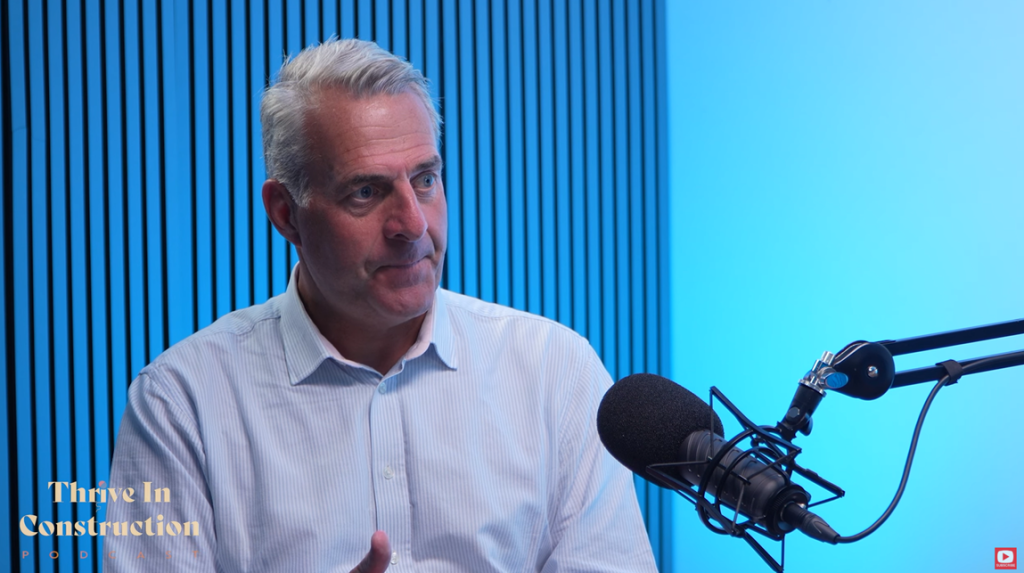
 In this Thrive in Construction episode, Bentley executive and former army officer Nathan Marsh unpacks how elite sport, military service and digital transformation in construction intersect. From losing well to using digital twins to squeeze out waste, he shares a playbook for leaders under pressure.
“Projects don’t go wrong – projects start wrong. Your job as a leader is to stack the odds in everyone’s favour before you break ground.” — Nathan Marsh
Big infrastructure only works when character and computation pull in the same direction. Nathan argues that the next decade belongs to leaders who can marry lived experience with digital transformation in construction, people who are as comfortable talking about setbacks and succession as they are about data, digital twins and risk.
Years in the forces and professional rugby taught Nathan how to win, how to lose and how to keep going when the scoreboard looks ugly. That shows up on construction and infrastructure programmes as:
Respect for performance – even when you’re on the wrong side of the result
Visible composure when “you’re always on parade” as the leader
Relentless review: what did we learn, what would we do differently, what do we keep?
Perspective — an understanding that however bad a programme review feels, it’s not life and death
For senior leaders, this mindset underpins digital transformation in construction: you can’t change culture, tooling or delivery models if you panic at the first piece of bad news.
Nathan’s answer is brutally simple: acknowledge the loss, mine it for insight, then move. Losing well isn’t spin; it’s about:
Naming what happened, without blame or denial
Respecting a strong performance from others, even if it exposed your gaps
Modelling calm, clear communication when the team is watching your every reaction
Treating each setback as fuel for the next iteration of digital transformation in construction in your organisation
That ability to absorb pressure and stay constructive is what your board, partners and site teams remember long after the incident report is filed.
When you’re the person with your head above the parapet, Nathan suggests three anchors:
Commitments to yourself – the standards you’ve set about how you’ll show up, regardless of weather or headlines.
Commitments to others – who you’ll let down if you don’t turn up, or if you turn up half-cooked.
A long view of character – seeing each hard day as one more deposit in the “character bank” you’ll draw on later.
This is where digital transformation in construction becomes personal: the tools and platforms only deliver if the humans around them believe they can find a way through the problem.
Nathan’s take: you should always be looking for the next version of you, and be secure enough to help them grow. That means:
Looking for the right blend of similarity and difference for the next phase
Matching leadership styles to project context, not ego
Accepting that “we’re all replaceable” and that’s healthy for resilient organisations
In a world of rapid digital transformation in construction, hanging onto the reins for too long can slow the team more than it protects you.
Nathan’s journey in army, insurance, EY, engineering, tier-one contracting and now Bentley, wasn’t a neat masterplan. But looking back, it built a rare mix: risk, finance, delivery and technology across the full asset lifecycle.
That mix is exactly what’s needed to make digital transformation in construction real: moving from slide-ware to live use of digital twins, cloud platforms and interoperable tools on major programmes.
Nathan describes a digital twin as a rich, data-driven representation of a real-world asset: a place to design, engineer, construct and even “test-run” a project before you commit on site.
Used well, digital twins in the context of digital transformation in construction:
De-risk early decisions by letting teams “measure three times, cut once”
Bring designers, contractors, operators and investors into the same virtual space
Reveal time, cost and carbon hotspots long before they become headlines
Turn data from noise into targeted insight your teams can actually act on
For sustainability-minded leaders, that includes modelling embodied and operational carbon and then choosing lower-impact options with confidence.
Nathan points to live examples where digital twins have:
Reduced design time by over 30% and cut construction programmes by months
Saved tens of millions in project costs by tightening quantities and logistics
Identified hundreds of thousands of tonnes of carbon that could be engineered out
The lesson for anyone serious about digital transformation in construction is clear: treating digital twins as “nice to have” means voluntarily taking more risk, more waste and more re-work than you need to.
It’s not a lack of tools; it’s confidence, skills and focus. Many organisations are still at mixed levels of digital maturity. Nathan’s prescription:
Make owning and governing data a board-level concern, not an IT side-quest
Start with one high-value use case – for example, using a twin to interrogate carbon on a major package
Pair project teams with vendors who can train, coach and co-deliver, not just sell licences
Use the early wins to build a narrative around digital transformation in construction that’s about performance, not buzzwords
Done this way, pilots evolve into standard practice instead of orphaned experiments.
Digital twins and advanced software only deliver value when the underlying assumptions are sound. That’s where robust building physics, fabric-first thinking and carbon literacy come in.
At Darren Evans Ltd, we help clients who are serious about digital transformation in construction to:
Map where performance risk really sits across an asset or programme
Prioritise interventions that cut both carbon and cost, using the best available tools
Translate complex technical outputs into decisions boards and funders can back
This is the kind of work we support at Darren Evans Ltd. If this resonates with your challenges, let’s talk.
Because tools don’t make hard calls, people do. Nathan’s story shows that humility, resilience and the ability to “lose well” are the bedrock of digital transformation in construction. Without that, even the most advanced twin becomes an expensive 3D picture.
Pick one flagship project or programme and treat it as your learning lab. Define a specific outcome. For example, reducing re-work or embodied carbon, and apply digital transformation in construction to that challenge only. Capture the savings, the lessons and the stories, then scale.
If you’re 18–25 and wondering where to build a career, Nathan’s advice is simple: infrastructure is real, long-term and changing fast. Getting involved in digital transformation in construction now lets you shape assets that will outlast you. Bridges, railways, utilities, while building skills that will stay in demand for decades.
In a sector where projects have national consequences, the edge belongs to leaders who can combine battlefield calm, changing-room honesty and digital transformation in construction to deliver assets that are safer, leaner and genuinely future-ready.